 HireFly Blog
EPFO Wage Ceiling Increased to ₹25,000: What Employees, HR and Employers Need to Know
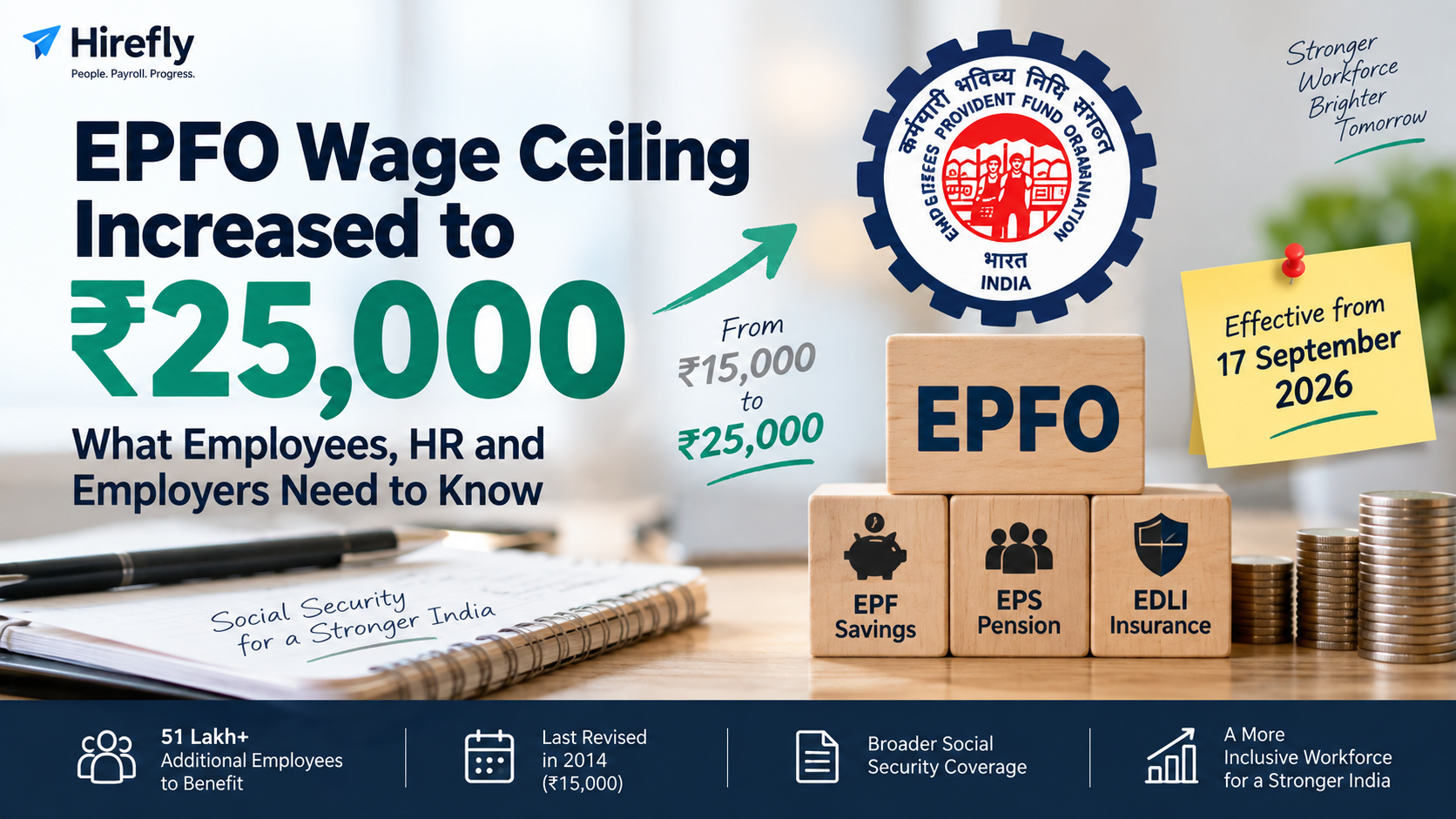
The Government of India has approved a major change to the Employees’ Provident Fund Organisation (EPFO) framework by increasing the wage ceiling for mandatory EPFO coverage from ₹15,000 to ₹25,000 per month.
The Union Cabinet approved the proposal of the Ministry of Labour and Employment on 16 September 2026. According to the government, the revised limit is expected to bring more than 51 lakh additional employees under mandatory EPFO coverage.
The new wage ceiling comes into effect from 17 September 2026, coinciding with Vishwakarma Jayanti.
For employees, this means a wider section of the workforce will receive statutory social security protection. For employers and HR professionals, the change is important from a payroll, compliance and employee-benefits perspective.
Here is what the new ₹25,000 EPFO wage ceiling means and how it could affect employees and organisations.
What Has Changed in the EPFO Wage Ceiling?
Until now, the wage ceiling used for determining mandatory EPFO coverage was ₹15,000 per month.
A fresh employee joining an EPF-covered establishment with wages above ₹15,000 was generally not automatically brought within mandatory EPF coverage, subject to the applicable EPF rules and the employee's circumstances.
The government has now raised this threshold to ₹25,000 per month.
In simple terms:
Previous EPFO wage ceiling: ₹15,000 per month
New EPFO wage ceiling: ₹25,000 per month
Increase: ₹10,000 per month
Effective date: 17 September 2026
This is the first revision of the wage ceiling since September 2014, when it was increased to ₹15,000.
Why Has the Government Increased the EPFO Limit?
The ₹15,000 ceiling had remained unchanged for around 12 years.
During this period, salaries, minimum wages and general income levels have increased considerably. As a result, many workers earning relatively modest salaries were nevertheless above the existing ₹15,000 threshold.
The government said the new ₹25,000 ceiling is intended to reflect sustained wage growth, rising incomes and the continued expansion of formal employment.
Increasing the threshold allows a larger section of India's workforce to come automatically within the statutory social security system.
Who Will Benefit From the New ₹25,000 EPFO Limit?
The most significant impact will be on employees whose applicable wages fall between ₹15,000 and ₹25,000 per month.
Under the earlier threshold, a new employee joining with wages above ₹15,000 could remain outside mandatory EPF coverage.
With the ceiling moving to ₹25,000, a substantial number of employees within this wage band will now fall under mandatory EPFO coverage, subject to the applicable provisions of the EPF schemes.
According to the Government of India, the change is expected to bring more than 51 lakh additional employees within mandatory EPFO coverage.
This is therefore not simply a change in a payroll number. It represents a substantial expansion of formal social security coverage.
What Benefits Will Newly Covered Employees Receive?
Employees brought under EPFO coverage can receive social security protection through the schemes administered by EPFO.
These primarily include:
Employees’ Provident Fund (EPF)
EPF is a long-term savings mechanism where contributions are made during employment. The accumulated amount, along with applicable interest, can provide financial support for retirement and certain permitted withdrawals.
Employees’ Pension Scheme (EPS)
EPS provides pension-related benefits to eligible members according to the applicable scheme conditions, including factors such as pensionable service and pensionable salary.
Employees’ Deposit Linked Insurance Scheme (EDLI)
EDLI provides life insurance protection linked to EPF membership, subject to the applicable eligibility conditions and scheme rules.
Therefore, bringing more workers within EPFO coverage can provide more than just retirement savings. It can also extend pension and insurance protection to employees who previously remained outside mandatory coverage.
Does the ₹25,000 Limit Mean Everyone Will Pay PF on ₹25,000?
Not necessarily.
This is an important distinction for employees and payroll professionals.
The government's decision raises the wage ceiling for mandatory EPFO coverage from ₹15,000 to ₹25,000. It should not simply be interpreted as saying that every employee's PF deduction will automatically be calculated on ₹25,000.
Actual EPF, EPS and employer contribution calculations depend on the applicable provisions of the EPF schemes, the employee's wages, membership status and other relevant conditions.
Employers and payroll teams should therefore follow the final statutory and administrative implementation instructions issued by the Ministry of Labour and Employment and EPFO rather than applying a blanket ₹25,000 calculation to every employee.
A Simple Example
Consider a new employee joining an EPF-covered organisation with applicable monthly wages of ₹20,000.
Under the earlier ₹15,000 mandatory coverage ceiling, an employee joining above the threshold was not automatically covered merely on the basis of the statutory wage ceiling.
With the ceiling increased to ₹25,000, an employee at ₹20,000 now falls within the revised wage range for mandatory coverage, subject to the applicable scheme provisions.
This illustrates why the change is particularly relevant to entry-level and lower-to-mid salary employees earning between ₹15,000 and ₹25,000.
What Does This Mean for HR and Payroll Teams?
The EPFO wage ceiling increase is particularly important for HR professionals, payroll teams and employers.
Organisations should review their existing payroll and PF processes to understand which employees may be affected by the revised threshold.
HR and payroll teams may need to:
identify employees who fall within the newly covered wage range;
review new-joiner EPFO eligibility processes;
update payroll configurations where necessary;
check employee and employer contribution treatment under the revised rules;
update onboarding and employee-benefit documentation;
communicate relevant changes clearly to employees;
review HRMS or payroll software settings; and
monitor further EPFO circulars, notifications and implementation instructions.
Companies using automated payroll or HRMS platforms should also check whether their service provider has updated the system to reflect the revised statutory ceiling.
Employers should avoid changing payroll calculations solely on the basis of news reports. The Ministry of Labour and Employment and EPFO are undertaking the necessary statutory and administrative steps for implementation.
Will Employees' Take-Home Salary Change?
For some newly covered employees, mandatory EPFO participation may affect the structure of their monthly salary and take-home pay because applicable employee contributions may be deducted through payroll.
However, the exact impact cannot be determined simply from an employee's gross monthly salary.
It can vary depending on the salary structure, applicable wages for EPF purposes, employer policies, existing EPFO membership and the detailed implementation of the revised provisions.
Employees should therefore check their salary structure or speak with their HR/payroll department rather than assuming that a specific amount will automatically be deducted.
What Is the Impact on Employers?
The change could also increase social security obligations for establishments employing workers who fall within the newly covered salary range.
Employers may have to account for additional eligible employees while processing EPFO contributions.
The government has also highlighted possible longer-term benefits for employers. Wider social security coverage can support employee retention, workforce stability and employee morale by providing workers with stronger formal social security protection.
For HR teams, this makes PF compliance increasingly important as part of the overall employee experience rather than treating it only as a payroll function.
Why Is This Change Significant?
The last revision took place in September 2014, when the wage ceiling was increased to ₹15,000.
India's labour market and wage levels have changed considerably since then.
According to the government, EPFO currently has around 7.98 crore contributing members across approximately 7.68 lakh contributing establishments. EPS also provides pension benefits to around 82 lakh pensioners.
Raising the mandatory coverage threshold to ₹25,000 therefore represents a significant expansion of India's formal social security framework.
Government Expenditure on the Change
The government estimates an annual outgo of approximately ₹11,339 crore following the enhancement of the wage ceiling.
The existing annual budgetary support is around ₹10,250 crore.
According to the official Cabinet announcement, estimated expenditure over five years is approximately ₹56,696 crore.
The proposal went through inter-ministerial consultations and was recommended by the Expenditure Finance Committee at its meeting on 16 June 2026 before receiving Cabinet approval.
When Does the New ₹25,000 EPFO Wage Ceiling Start?
The revised EPFO wage ceiling takes effect from 17 September 2026.
The Ministry of Labour and Employment and EPFO are responsible for completing the necessary statutory and administrative steps required to implement the Cabinet decision.
Employers and HR professionals should therefore keep track of subsequent official EPFO notifications, circulars and payroll instructions.
Frequently Asked Questions
What is the new EPFO wage ceiling in 2026?
The Union Cabinet has approved increasing the wage ceiling for mandatory EPFO coverage from ₹15,000 to ₹25,000 per month.
When is the new EPFO ₹25,000 limit effective?
The revised wage ceiling takes effect from 17 September 2026.
What was the previous EPFO wage ceiling?
The previous wage ceiling was ₹15,000 per month, which had been in place since September 2014.
How many employees are expected to benefit?
The government estimates that more than 51 lakh additional employees will come within mandatory EPFO coverage.
Will PF now be deducted on ₹25,000 for every employee?
No. ₹25,000 is the revised wage ceiling for mandatory coverage. Actual contribution calculations depend on the applicable EPF/EPS provisions, wages, membership status and other relevant conditions.
Which employees are most affected by the change?
The change is particularly relevant to employees in the ₹15,000 to ₹25,000 wage band who may now fall within mandatory EPFO coverage.
Does the change include pension benefits?
Employees covered under the EPFO framework can have access to pension protection through the Employees’ Pension Scheme (EPS), subject to the applicable scheme rules and eligibility requirements.
Does EPFO coverage include insurance?
Yes. EPFO also administers the Employees’ Deposit Linked Insurance Scheme (EDLI), which provides insurance protection linked to EPF membership subject to the applicable rules.
What Employees Should Do Now
Employees do not need to panic or make assumptions about immediate changes to their salary.
If your wages fall between ₹15,000 and ₹25,000 and you are unsure how the revised ceiling affects you, check with your employer's HR or payroll department. Employees should also watch for official communication from EPFO regarding implementation.
For existing EPFO members, the effect can differ depending on membership and contribution circumstances, so individual cases should be checked against the applicable EPFO rules.
What Employers Should Do Now
Employers should begin assessing how many employees and future recruits could fall within the revised threshold.
Payroll systems, onboarding procedures, statutory compliance processes and employee communications may require updates. HR teams should also ensure that employees understand the difference between the mandatory coverage ceiling and the amount on which PF contributions are actually calculated.
Further implementation instructions from EPFO should be reviewed carefully before finalising payroll changes.
Final Takeaway
The increase in the EPFO wage ceiling from ₹15,000 to ₹25,000 per month is one of the most significant changes to mandatory EPFO coverage in more than a decade.
With more than 51 lakh additional employees expected to come under mandatory coverage, the change expands access to provident fund savings, pension protection and EPFO-linked insurance for a larger section of India's workforce.
For employees earning between ₹15,000 and ₹25,000, it is particularly important to understand how the new rules apply to their employment. For HR and payroll professionals, the immediate priority should be reviewing employee eligibility, payroll processes and subsequent EPFO implementation instructions.
As the revised ceiling takes effect from 17 September 2026, employers and employees should rely on official EPFO and Ministry of Labour and Employment notifications for detailed implementation requirements.
Sources: Government of India, Press Information Bureau; Prime Minister's Office; Ministry of Labour & Employment. Information checked on 16 September 2026.
Disclaimer: This article is intended for general informational purposes and does not constitute legal, tax, financial or professional advice. EPFO rules and implementation requirements may be updated through subsequent notifications or circulars. Employers and employees should refer to official EPFO and Ministry of Labour and Employment communications for requirements applicable to their circumstances.